| Review: Low
Cost Shotgun Microphone Comparison |
 July, 2001
Low
Cost Shotgun Microphone Comparison
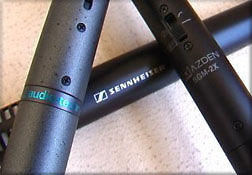
Audio-Technica
AT835b
Azden SGM-2X
Sennheiser K-6/ME-66/ME-67
Review by Dan Brockett
The Common Question
In order to supplement the amazingly
high quality images that DV users are creating with low cost
DV camcorders, many users are discovering during the editing
process how important audio is in effectively telling their stories.
Whether you produce documentaries, feature films, corporate communications
or wedding videos, the quality of your soundtrack is what immediately
quantifies your work with your audience. It's really pretty simple,
bad audio equals amateurish, high quality audio equals professional.
Hopefully, this review will serve
as the first in series of reviews in helping you assemble a decent
quality, relatively low cost professional field audio kit for
your productions. OK, now we're all in agreement that good audio
is important, right? In case you haven't figured it out yet,
the camcorder-mounted microphones that are standard issue on
most DV camcorders are really about as useful as a breadstick
in gathering high quality audio. Besides being mounted directly
on the camcorder (a big no-no), the sound quality on the microphones
that are included with most consumer/prosumer camcorders ranges
from bad to worse. A logical first purchase for a field audio
package is higher quality main microphone. Notice how I said
"main" microphone? I have been asked many times about
which microphone to purchase as "a good all-purpose"
microphone. Truth be told, there is no such thing. Microphones
are kind of like golf clubs, there are different types of clubs
for different purposes and shots. Microphones are the same. More
about this later. But in the meantime, a shotgun microphone is
the best place to begin in assembling a versatile field audio
package that will serve you well under 80 to 90% of the sound
situations that occur on most projects. It's also one of the
only pieces of a good field audio kit that you can begin to use
immediately without many other pieces of support equipment, therefore
increasing your audio quality as you build your field audio kit.
The First Step?
"Shotgun mic" is actually
a generic term that has come to classify microphones of several
types. The "shotgun" mic used to typically be a true
condenser (externally powered) long microphone, but has now come
to mean almost any long barreled microphone with a narrow acceptance
angle.
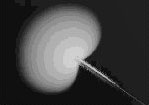
Cardioid |
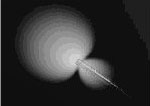
Super Cardioid |
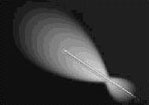
Lobar/Gun |
These could include various types of
mics termed by their manufacturers as "cardioid", "super
cardioid", and "lobar/gun " as well as several
other "creative" terms. In a typical field audio kit,
the shotgun mic is typically the sound source for around 50 to
70% of what you hear actually ending up in the final mix for
films and television. The reason is that, correctly used, a shotgun
microphone will pick up the voices of the talent with a comfortable
amount of the surrounding ambient sound. Unlike the sterile,
close mic'd sound that is typical with a lavaliere microphone,
the shotgun mic usually exhibits a fuller, richer and more pleasing
sound quality. However, it is a mistake to think of a shotgun
mic as a magical device that can only selectively pick up a specific
sound while totally rejecting all sounds to the side or rear
of the microphone. The way sound behaves is more complex than
can be explained in this review, but suffice it to say, a shotgun
mic is the correct tool for many audio tasks but it is not an
all-purpose solution to every audio challenge. The shotgun mic
is the logical place to begin in building a high quality field
audio package.
Criteria For The Candidates
The purpose of our review was to examine
and test shotgun microphones in a realistic price frame for most
DV users, the majority of whom did not pay more than $3,500.00
for their DV camcorders. Most Canon GL-1 owners would not invest
$2,000.00 for a high-end shotgun microphone because most DV users
tend to view audio acquisition as an afterthought so reviewing
high-end shotgun microphones like the Neumann KM82i or the Sanken
CS5 that cost almost as much as the average DV camcorder was
not an option for this review. Instead, we focused on the low
end of the scale. How high quality is the sound reproduced from
a $250.00 microphone? As compared to a $400.00 microphone? How
much difference is there in the sound quality produced by these
low cost units versus their higher priced cousins? Is the sound
quality produced by these microphones good enough for television?
Theater sound systems? How should these mics be used? We set
out find out the answers to these questions and what we encountered
in our tests may surprise you. We decided to review shotgun microphones
available for a street price of between $250.00 and $400.00 and
approached several microphone manufacturers.
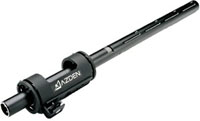
Azden Corporation provided us with a sample of their
SGM-2X Microphone System.
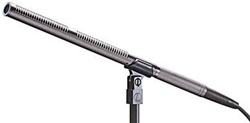
Audio-Technica offered
their AT835b shotgun.
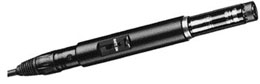
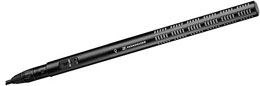
Sennheiser provided
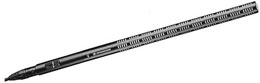
the modular K6 power supply along with the ME-66 short shotgun
capsule and the ME-67 long shotgun capsule.
An MCE86 S.1 shotgun mic was requested from Beyerdynamic
for review but the company refused to provide a test sample so
that particular microphone was not reviewed here.
Typical Uses For Shotgun Microphones
After much discussion, we decided that
most DV users would probably mainly use a shotgun microphone
in one of three typical recording scenarios.
Camcorder Mounted
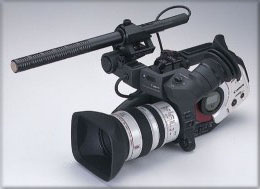
As the owner of a sound design/audio post facility, I cringe at the phrase, "camcorder mounted mic" but the facts of life are that many DV users do cover live event, documentary type situations, working alone without a sound recordist , and are specifically interested in how well a microphone mounted on their DV camcorder will perform. We tested all three microphones mounted on our Sony TRV-900 DV camcorder with a Beachtek Systems XLR adaptor plate and a Lightwave Systems Universal Mini Mount with a two inch height extension to remove the tip of the mic from the upper portion of the picture. This extension is needed on most of the smaller camcorders but may or may not be necessary on a larger unit like a Canon XL-1 or Sony PD-150.
 Boom
Mounted
Boom
Mounted
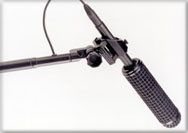
This is the preferred method of working with a shotgun mic and
the method used in 90% of all professional work. The advantage
is that the shotgun can be brought much closer to the talent
or subject's proximity, thereby resulting in a much better signal
to noise ratio, isolating the talent or subject's sound effectively
from unwanted ambient sound while still retaining the richness
and superior bass response that a shotgun records as compared
to most other types of mics. The downside is that you must use
a bigger crew, using the shotgun/boompole with at least with
a boom operator/mixer or preferably, with a separate mixer and
boom operator. It takes a crew of least two and preferably three
to really work well with a single camera and a shotgun/boompole.
We tested the microphones using a Lightwave Systems Universal
Mini-Mount and Zeppelin mounted on a carbon-fiber Gitzo 11 foot
boompole on a variety of shooting situations including informal
"run and gun" setups, two camera sit down interviews
and Steadicam "walk and talks". The mics were recorded
through a PSC M4MkII four channel field mixer into several camcorders
including a Sony TRV-900 using a Beachtek Systems XLR adaptor
plate, a Sony DSR-500WS camcorder and a Canon XL-1 camcorder,
as well as an HHB MDP-500 Professional Mini Disc recorder.
 Sound
and Sound Effect Gathering
Sound
and Sound Effect Gathering
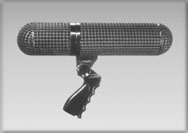
For this test, we plugged each microphone directly into the XLR
inputs of an HHB MDP-500 Mini Disc recorder. The Lightwave Systems
Universal mini mount and Zeppelin were detached from the Gitzo
boompole and the mics were used with the handgrip for placement
near various specific sound sources and also in and around various
sound environments that would typically be recorded for ambient
and sound effect gathering including several specific office
sound effects, ambient sources including a children's playground,
a shopping mall food court and several other locales.
So How Were They Different?
Here is where it got interesting. The
Azden SGM-2X is actually a microphone system. When you purchase
the SGM-2X, the kit includes a short barrel power supply/base,
which is powered by a single "AAA" 1.5V battery as
well as a long barrel capsule, which turns the system into a
long shotgun mic. That's just the beginning though. Besides the
long shotgun capsule, the kit includes short capsule which when
combined with the power supply, results in an omni-directional
cardioid mic. The kit also includes a long foam windscreen for
the shotgun, a short foam screen for the omni cardioid configuration
and a camera mounted universal shock mount. The kit even includes
extra replacement "elastic bands" for the included
shock mount. The system does not ship with a carrying case though.
Very nice extras in this offering, especially considering that
this mic was the second lowest price of the three units tested.
No mention is made in the Azden owner's manual as to whether
the SGM-2X can also be phantom powered from a mixer or camcorder's
XLR jack.
The Audio-Technica AT835b is the company's
low cost line+gradient condenser shotgun. The AT835b came in
a nice plastic case and also included a long foam windscreen,
a standard 5/8" mic mount (non-suspension) and the required
"AA" 1.5V battery. The AT835b may also be phantom powered
from any DC 9-52 volt system. The AT835b is not a mic system
and is not expandable as are the two other systems we tested.
The Sennheiser K-6/ME-66/ME-67 is also
a microphone system, much like the Azden SGM-2X. The K6 module
is the power supply, the ME-66 is a short shotgun capsule and
the ME-67 is a long shotgun capsule. Unlike the Azden, the Sennheiser
system components must be purchased separately though. Just like
the Audio-Technica, the K6 module includes a primitive (non-suspension)
mic mount, the required "AA" 1.5V battery and a carrying
case. The K6 power module can be powered by an internal "AA"
1.5 V battery or by external phantom power 12-48V from a mixer
or camcorder. If for some reason, you would like to have the
K6 powered only from phantom power with no option for "AA"
battery power, the K6P is available and is only phantom powered.
More on the significance of using the phantom power versus "AA"
batteries later.
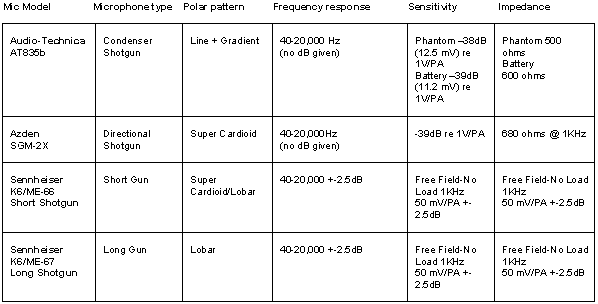
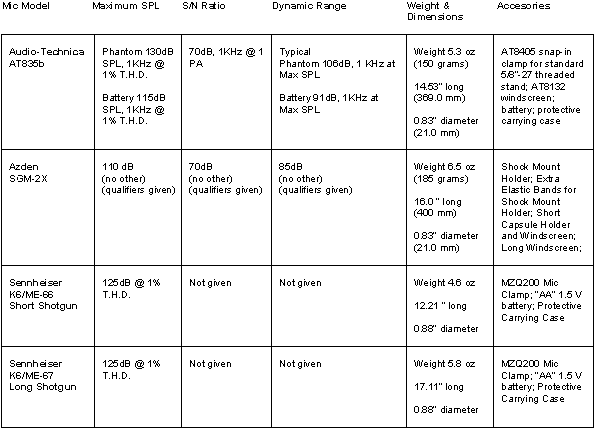
Below is a comparison table, detailing
the features of each of the three mic systems.
Profiles
Audio-Technica AT835b
$239.99 Street Price
Audio-Technica U.S., Inc.
1221 Commerce Drive, Stow, Ohio 44224
http://www.audio-technica.com
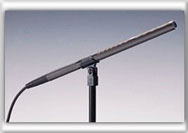 With a street price of just $239.99, the Audio-Technica was the
least expensive mic we tested. According to Audio-Technica, "the
AT835b is a wide-range condenser microphone with a line + gradient
polar pattern designed to provide the narrow acceptance angle
desirable for long distance sound pickup." Finished in matte,
dark copper finish, the AT835b had a distinct, typically "Audio-Technica"
look and feel. The tiny recessed bass roll-off control provides
a 180 Hz, 12dB/octave roll-off. The location and design of this
important control is a mixed blessing. It's impossible to accidentally
turn on or off which is good for the field, but it also makes
it exceedingly difficult to A/B compare the mic's sound with
and without the bass roll-off. The overall look and feel of the
AT835b is one of quality and the mic has the heft and feel of
serious pro audio equipment. In our opinion, it is as difficult
to quantify the sound qualities of microphones as it is to quantify
the sound qualities of audio monitors. Listed below are several
comments and observations about the sound qualities of the AT835b
With a street price of just $239.99, the Audio-Technica was the
least expensive mic we tested. According to Audio-Technica, "the
AT835b is a wide-range condenser microphone with a line + gradient
polar pattern designed to provide the narrow acceptance angle
desirable for long distance sound pickup." Finished in matte,
dark copper finish, the AT835b had a distinct, typically "Audio-Technica"
look and feel. The tiny recessed bass roll-off control provides
a 180 Hz, 12dB/octave roll-off. The location and design of this
important control is a mixed blessing. It's impossible to accidentally
turn on or off which is good for the field, but it also makes
it exceedingly difficult to A/B compare the mic's sound with
and without the bass roll-off. The overall look and feel of the
AT835b is one of quality and the mic has the heft and feel of
serious pro audio equipment. In our opinion, it is as difficult
to quantify the sound qualities of microphones as it is to quantify
the sound qualities of audio monitors. Listed below are several
comments and observations about the sound qualities of the AT835b
Camcorder Mounted
"At 14.5" long, this is pretty unwieldy on a camcorder
like a TRV-900 or a GL-1. It works but is a little long."
"Nice isolation from shock and handling noise"
"Very precise sound with a lot of detail"
"Lower noise than the Azden"
"Sounds pretty clean for the least expensive mic"
"With the bass rolled off, I think it's too thin sounding"
Boom Mounted
"It say right in the literature not to leave it in open
sun or in areas where temperatures exceed 110 degrees F for long
periods of time or use it in high humidity areas. Kind of like
a Schoeps. Perhaps a little fragile or just their lawyers being
prudent?"
"Fairly directional with good rejection of off-axis noise"
"Doesn't react at all to handling noise on the boom pole.
This is a mixed bag as it's nice but it also can indicate a lack
of sensitivity"
Sound Gathering
"Very impervious to handling noise"
"Output seems right on par with the Azden."
"In looking over the frequency response, there is a definite
bump at around 8-10KHz"
"Good for overly bassy environments"
"A little thin sounding for my taste"
If you think about it, this mic
sounds pretty amazing for less than $240.00. A mic like this
ten or fifteen years ago would have cost easily over $800.00
to have the same quality of build and sound. The AT835b comes
from Audio-Technica with a standard one year parts and labor
warranty. The unit is rated at 1200 ours of continuous use with
a standard "AA" 1.5V battery or if you would like to
use it as most professionals would, it will run happily on almost
any phantom power source you care to feed it.
Azden SGM-2X
$249.99 Street Price
Azden Corporation
147 New Hyde Park Road
Franklin Square, N.Y. 11010
http://www.azdencorp.com
 With a street price of just $249.99, the Azden definitely seemed
to be an outstanding value in comparison to the other mics we
tested. The Azden included a short capsule and extra windscreen
that basically turns your shotgun mic into an omni-directional
cardioid. The fact that this is included in the $249.99 street
price is quite impressive. The included shock mount is the inexpensive,
"elastic band" type that frankly, doesn't do a really
great job in isolating the mic from bumps and thumps as well
as regular handling noise when camcorder mounted. We tested the
Azden as well as the other mics with a LightWave Systems Universal
Mini Mount that costs nearly as much as this mic, but it did
make a huge difference in the sound quality during a typical
session with camcorder movement. Although the extras included
in the price are nice, we were most interested in the sound quality
of the SGM-2X. Other than an informal listening, we didn't test
the SGM-2X's omni cardioid capabilities as we felt that most
prospective buyers would mainly care mostly about the performance
of the shotgun configuration. The SGM-2X does feature an easy
to adjust bass roll-off (200Hz 6dB/Octave) control as part of
the main power switches operation. This made it much easier to
A/B compare the sound with and without the mic's bass roll-off
on the SGM-2X than with the other mic's tiny, recessed bass roll-off
controls.
With a street price of just $249.99, the Azden definitely seemed
to be an outstanding value in comparison to the other mics we
tested. The Azden included a short capsule and extra windscreen
that basically turns your shotgun mic into an omni-directional
cardioid. The fact that this is included in the $249.99 street
price is quite impressive. The included shock mount is the inexpensive,
"elastic band" type that frankly, doesn't do a really
great job in isolating the mic from bumps and thumps as well
as regular handling noise when camcorder mounted. We tested the
Azden as well as the other mics with a LightWave Systems Universal
Mini Mount that costs nearly as much as this mic, but it did
make a huge difference in the sound quality during a typical
session with camcorder movement. Although the extras included
in the price are nice, we were most interested in the sound quality
of the SGM-2X. Other than an informal listening, we didn't test
the SGM-2X's omni cardioid capabilities as we felt that most
prospective buyers would mainly care mostly about the performance
of the shotgun configuration. The SGM-2X does feature an easy
to adjust bass roll-off (200Hz 6dB/Octave) control as part of
the main power switches operation. This made it much easier to
A/B compare the sound with and without the mic's bass roll-off
on the SGM-2X than with the other mic's tiny, recessed bass roll-off
controls.
Listed below are several comments
and observations about the sound qualities of the SGM-2X
Camcorder Mounted
"This thing looks ridiculous on a DV camcorder. It's way
too long"
"Great bass response even with the bass roll-off on"
"More 'grit' than either the Sennheiser or Audio-Technica"
"Sounds very 'rich and thick' to my ear"
Boom Mounted
"It's more directional than the Audio-Technica"
"Impressive rejection of off-axis noise"
"Fairly sensitive to handling noise"
"Good basic sound but not a lot of detail"
"I can actually hear some hiss with headphones on"
Sound Gathering
"I really like having the bass roll-off easy to access.
There are times when you want to not use it and it's easier to
decide whether to use the bass roll-off with this than with the
others"
"The output level is decent but a little on the lower end"
"Good for thin sounding voices"
"Constructed OK but you can tell it's little a less expensive"
The SGM-2X can also be converted
to a wireless mic unit although we generally avoid wireless mics
like the plague unless we have to use them and we have never
tested or used an Azden wireless. The SGM-2X comes from Azden
with a standard two year parts and labor warranty. The lack of
phantom power specifications (I didn't want to chance damaging
the unit since it was on-loan) and the fact that the unit requires
a "AAA" 1.5 V battery versus the two other brands which
use the more common "AA" could be seen as a slight
disadvantage. "AAA" batteries are easy to obtain, it's
just that every other piece of audio gear seems to use "AA"
size batteries so having to keep "AAA"s around as well
could be a little inconvenient. This mic is rated at a 1,000
hour battery life from the single "AAA".
The testing staff seemed to be
divided about half and half in regards to the sound quality of
the SGM-2X. Half felt there was perhaps a little too much self-noise
and distortion, while the other half of the testing staff liked
the richness and bass response that the Azden seemed to provide
that the other units tested seemed to lack. As stated previously,
to us, the sound qualities of microphones are akin to audio monitors,
each preference is very subjective depending on the listener's
preferences.
Sennheiser K6 with ME-66 and ME-67 Shotgun Capsules
$379.99 Street Price for K6 power module and either capsule
- $209.99 for extra capsule
Sennheiser USA
1 Enterprise Drive
Old Lyme, CT 06371
http://www.sennheiserusa.com
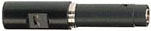


First, a little clarification is in order here. We tested the
Sennheiser K6 with both the ME-66 short gun capsule and with
the ME-67 long gun capsule. In our minds, the two capsules are
two separate products with different applications. The Sennheiser
combos were the most expensive mics we tested. The K6 with either
capsule can be bought at a street price of $379.99 and the extra
capsule can be picked up for a street price of $209.99. During
our time testing the Sennheiser mics, it became apparent to us
that if you need to mic more than one talent with one boom operator
or if you are shooting in sound controlled environments like
sound stages, the ME-66 had a very nice, open sound with medium
rejection of off-axis noises. However, if you are shooting in
practical locations or need more rejection of off-axis noise
than the ME-66 or either of the other two mics tested here can
provide, the ME-67 is a superior long shotgun. The construction
the two units was typical of products from Germany, minimalist
design with very high quality construction. So what does your
extra approximately US $130.00 over either of the other two mics
buy you? A slightly more refined sound quality with both the
ME-66 and the ME-67, although at almost 18" long, the ME-67
was too long to practically mount on a mini DV camcorder in our
opinion.
Listed below are several comments and
observations about the sound qualities of the K6/ME-66/ME-67
(Each comment is marked as to which capsule was being used)
Camcorder Mounted
"This is the perfect size for a DV camcorder" (ME-66)
"Wow, in comparison to the other mics, this thing has twice
the output level of the other two" (ME-66)
"This thing is way too long to use on a camcorder like this
(TRV-900)" (ME-67)
"More bass than the Audio-Technica but less full then the
Azden" (ME-66)
"This mic works great with the Lightwave Mount and the windsock"
(ME-66)
"This is a great pickup for camcorder mounting. Less directional
than the Azden or Audio-Technica" (ME-66)
Boom Mounted
"It's more directional than any other mic I've ever used
except the 816T"(ME-67)
"It aims like a gun. Very directional" (ME-67)
"This mic has a very nice, smooth open quality. Perfect
for two shots and flipping between the two talents" (ME-66)
"I have the recording levels on the camcorder at almost
half of the level of the other two brands to get the same dB
output. The output is very hot!" (ME-66)
"Very quiet and very little of the off-axis noise from the
crew bleeds through. Great isolation" (ME-67)
Sound Gathering
"Without a doubt, the best overall sound of everything we
tried" (ME-66)
"Picks up more detail like the whoosh of the lever on this
L.E.D. clock" (ME-66)
"They call this a shotgun? It's almost more like an omni"
(ME-66)
"Sennheiser makes great stuff. I love this for location
or man-on-the-street stuff" (ME-67)
The K6 power module can also be converted
to lavaliere mic unit as well as well as a PZM, omni-cardioid
and a super cardioid. Very flexible. The K6 system comes from
Sennheiser with a standard one year parts and labor warranty.
If you refer to the specs of most dual
power system mics, you actually can obtain significantly better
performance using phantom power rather than batteries if you
have a mixer or camcorder with phantom power output. Everyone
who used the K6 system seemed to be impressed with the overall
sound quality. It was amazing how different the two capsules
sounded and performed. It is nice to have both capsules for maximum
flexibility in different shooting situations, but at close to
$600.00, it becomes more of a luxury for users on tight budgets.
Cut To The Chase!
So now the question comes up, "which
one (or two) to buy?". The good news is that with the right
skills and technique, excellent results could be obtained from
any of these mics. There was not a bad mic in the bunch. Just
like audio monitors, much of the final choice comes down to personal
preference.
If money is no object, (relatively speaking),
the Sennheiser K6 with both the ME-66 and ME-67 capsules would
be a great choice. Based upon this test, this is the system we
are going to purchase for our own lower budget DV projects. I
would encourage only users who will mostly shoot in sound controlled
environments or users who want to camcorder mount a shotgun to
go with the K6/ME-66 combo. If you typically are going to shoot
in practical locations versus soundstages, the ME-67 would probably
be a superior choice as far boom mounted work. The ME-67 is too
long and has too narrow angle of acceptance to be useful as a
camcorder mounted mic. In my opinion, the extra $130.00 is justified
in higher quality sound and a little more elegant look and feel
over the other two microphones. Don't forget though, with audio
equipment, the law of diminishing returns applies. What this
means is that as you go up in price, the quality of the product
and the product's performance go up, but in incrementally smaller
steps as the price range rises.
The Audio-Technica AT835b seems to be
a great choice if you shoot in many bass heavy environments with
high dB levels like live musical performances or have had problems
with muddy mixes. The AT835b was rated for significantly higher
dB levels than the other two units. The AT835b has a nice clear
tone that many will find appealing and the quality and reputation
are amazing for a $239.99 mic. An excellent value and a great
choice for DV users who just cannot or will not spend $400.00
for a shotgun for their inexpensive DV camcorder but need better
quality and more versatility than an on-camcorder mic can provide.
No nonsense or frills but gets the job done nicely in the right
hands. Not tested here, but available from Audio-Technica are
several variants of the AT835b, both longer and in stereo and
also higher line, more expensive shotguns.
The Azden SGM-2X is a bargain hunters
dream. It features decent sound and maximum versatility with
the inclusion of the included omni directional cardioid mic at
a $249.99 street price. Not to be overlooked is the Azden's standard
two year warranty versus a single year on both of the other mics.
Several of the testers liked the sound characteristics of the
SGM-2X while, conversely, several felt that it had a little more
self-noise and distortion than the Sennheiser or the Audio-Technica
units. Once again, there is a matter of preference in sound characteristics.
I would not recommend the Azden with high sound level projects
as much as the other two mics since to my hearing, the SGM-2X
distorted earlier than the other two mics with high sound levels.
But for average level interview and dialogue work, the SGM-2X
tended to slightly exaggerate proximity effect, which has the
end result of warming up thin-sounding voices, which can be a
big plus for weddings and corporate projects with "real
people" who tend to not project their voices or have nasal
or un-appealing voice qualities.
And now, to answer some questions I posed
at the beginning of this review:
Q-
How high quality is the sound reproduced from a $250.00 microphone?
How much difference is there in the sound quality produced by
these low cost units versus their higher priced "industry
standard" cousins?
A-
Surprisingly good. The sound reproduced from all of these microphones
lacked the fine detail and the pickup from distance was limited
in comparison to pricey offerings from Sennheiser, Schoeps, Neumann
and Sanken but at less than 1/4 of the cost of most of the industry
standard true condenser shotguns, the sound was quite good.
Q-
The $250.00 mic's sound as compared to a $400.00 microphone?
A-
Per my expectations, the $400.00 mic sounded better than the
$250.00 mics. But ask yourself, "where and how will most
of my work be reproduced?" If it's on mono VHS with a 2"
speaker, the difference will probably not be apparent to your
audience. If they cannot hear it, why pay for it?
Q-
Is the sound quality produced by these microphones good enough
for television?
A-
For the most part, yes. I know that the Sennheiser K6 system
is used by many news outlets and I have seen the Audio-Technica
on some episodic and cable series sets. The Azden is fairly new
to the market but I am sure that someone, somewhere is using
it for television.
Q-
What about in a feature for theater sound systems?
A-
OK, let's get real here. We are talking low-end mics. They are
amazing for the money but if it were my film or had my name on
it as sound recordist, I would buy, rent, beg, borrow or steal
to use a higher-end mic. Remember, in a theater, you have a lot
more dynamic range, detail and sensitivity than even the best
home theaters have so go for something a little better. But if
these are all you can afford, (and you're doing a theatrical
release project?), you could probably squeak by with these mics.
But most of the nuances of the sync sound would be lost on a
high dynamic range theatrical sound system. A good compromise
would be to rent or purchase a Sennheiser MKH-70 or Neumann KM82i.
But that's another article, right?
Hopefully, this review has been of help
to you in selecting the best low cost shotgun microphone for
your needs. In our next review article in the "Building
A Field Audio Kit" series, we will take a look at the choices
available for wired lavaliere microphones. Stay tuned for what
promises to be another set of tough but fun choices.
Dan Brockett is a film and video director and co-owns a film
and video production company, Big Little Films tm, Inc. and a sound design company, Noise
Control tm.
Dan is also
a guide on the premier Final Cut Pro information source, 2-Pop.com and he serves as Minister
of information and Vice President of the Los Angeles Final Cut
Pro Users Group.
Big
Little Films, Inc.
2955 E. Hillcrest Drive, Suite 121 Thousand Oaks, Ca. 91362 USA
Office (805) 496 8130 Fax (805) 496 4027 E-Mail: BLFilms@earthlink.net
copyright © Dan
Brockett 2001
All screen captures and textual
references are the property and trademark of their creators/owners/publishers.